Over the past months, remembrance and cultural heritage professionals from across Europe have come together for a unique learning journey through the project „Preserving the Past – Securing the Future: A Sustainable Approach to Cultural and Remembrance Heritage.“ The goal was to work together to determine how memorial sites can be made more sustainable, resilient, and future-proof.
Today, we are proud to celebrate the successful conclusion of this three-part workshop series, which took participants from Belgium, France, Germany, Italy, Poland and The Netherlands.
This initiative evolved from a series of workshops into a space for exchange, inspiration and collaboration among organisations dedicated to preserving the memory of communities and civilians who suffered during the Second World War, while also working to build a more sustainable future for their institutions and communities.
Three Destinations, One Shared Purpose
The journey began at the Juno Beach Centre in Normandy, France, a place deeply connected to the history of the Allied landings during World War II. Here, participants explored the foundations of sustainability in remembrance and cultural heritage organisations, reflecting on how museums, memorials, and visitor centres can balance preservation, education, and responsible environmental management.
The second workshop brought the group to Gdańsk, Poland, a city whose history is closely intertwined with the events of the Second World War. Discussions focused on social sustainability, community engagement, inclusion, accessibility, education, and human rights. Participants shared experiences from their own institutions and explored practical ways of making remembrance sites more relevant, welcoming, and resilient.
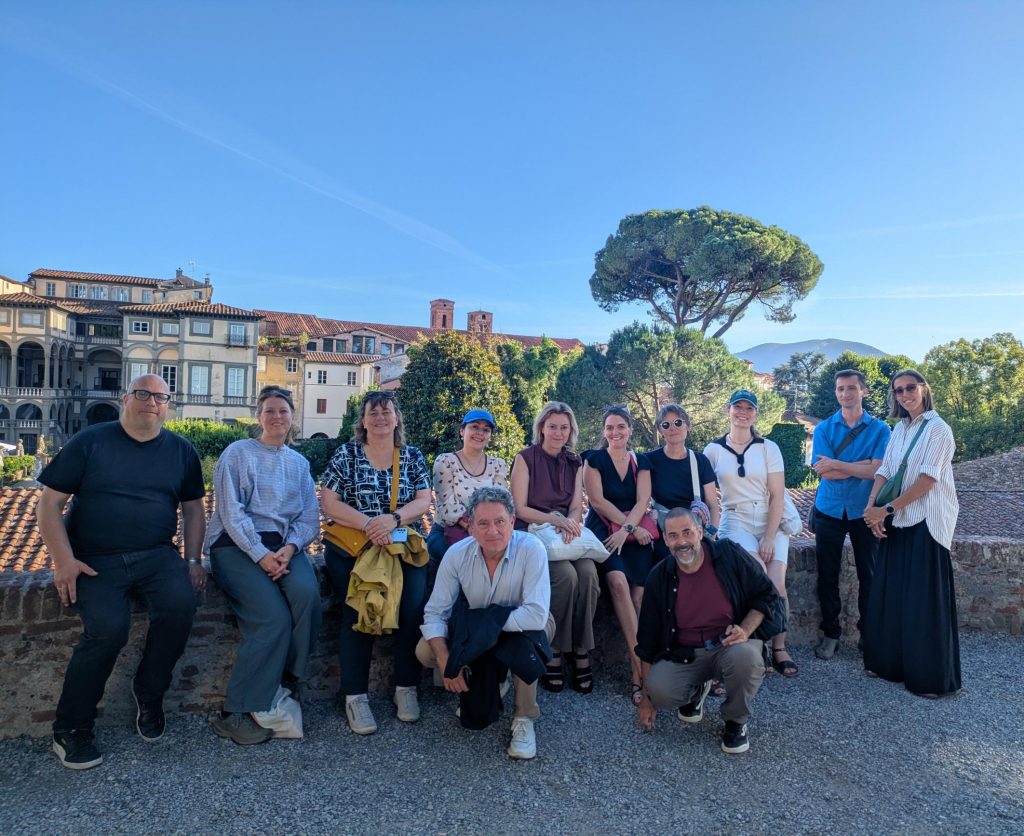
The final workshop took place in Lucca, Italy an important centre of resistance against fascism during the Second World War. Here the focus shifted to long-term sustainability, local economic impact, management, monitoring, fundraising, and communicating the broader value of remembrance work. Participants reflected on how their organisations contribute not only to historical understanding but also to democratic awareness, social cohesion, community wellbeing, and local development.
Learning from Each Other
One of the greatest strengths of the workshop series was the diversity of perspectives in the room. Participants represented organisations working at the intersection of cultural tourism and Second World War remembrance, bringing together different experiences, challenges, and good practices.
Throughout the programme, inspiring discussions took place around questions such as:
- How can remembrance institutions become more sustainable?
- How can they strengthen relationships with local communities?
- How can they demonstrate their value beyond visitor numbers?
- How can sustainability become part of everyday decision-making?
The workshops showed that, despite differences in size, location, or mandate, many institutions face similar challenges and that sharing experiences is one of the most effective ways to find solutions.
Sustainability in Practice
A particular highlight of the series was seeing participants move from theory to action. One of the series’ particular highlights was seeing participants move from theory to action. Each workshop was followed by a mentoring session in which participants presented their progress.
Institutions were encouraged to test ideas and implement practical sustainability measures between workshops, demonstrating that sustainability does not have to start with large-scale investments. Often, meaningful change begins with small but intentional steps: engaging local communities, improving accessibility, supporting local suppliers, strengthening staff awareness, or measuring impacts more effectively.
The exchange of these experiences created a valuable source of inspiration for everyone involved and reinforced the idea that sustainability is a continuous journey rather than a final destination.
A Dedicated Team Behind the Workshops
The workshop series was delivered by the mascontour team, consisting of Nicole, Maité, and Matthias, who guided participants through the various themes, facilitated discussions, and provided practical tools and examples from the tourism and heritage sectors.
Their goal throughout the project was to create a supportive environment where participants could learn from one another, challenge assumptions, and translate sustainability principles into concrete actions for their own organisations.
Thank You to Our Partners
Projects like this are only possible through strong partnerships and shared commitment.
A special thank you goes to our valued partner organisations:
- Juno Beach Centre, France
- Fondazione Campus Studi del Mediterraneo, Italy
- Liberation Route Europe (LRE) the lead organisation of the project.
Their dedication, expertise, and collaboration made it possible to bring together institutions from across Europe and create a meaningful platform for exchange and learning.
Looking Ahead
While the workshop series has come to an end, the conversations and connections created throughout the project will continue.
The participants return to their organisations with new ideas, practical tools, and a wider network of professionals who share the same commitment: preserving the stories of the past while ensuring that remembrance institutions remain relevant, resilient, and impactful for future generations.
Because sustainability in remembrance heritage is not only about protecting places and collections it is about strengthening the communities, values, and democratic awareness that these sites help to foster.
We are grateful to everyone who joined us on this journey and look forward to seeing how the ideas developed in Normandy, Gdańsk, and Lucca continue to grow in the years ahead.